I just finished up building our first bike outfitted with Shimano's new Dura Ace 7900 parts group, a fully custom
Parlee Z1. The build went extremely well and the bike weighs in at 15.6lbs (without pedals).

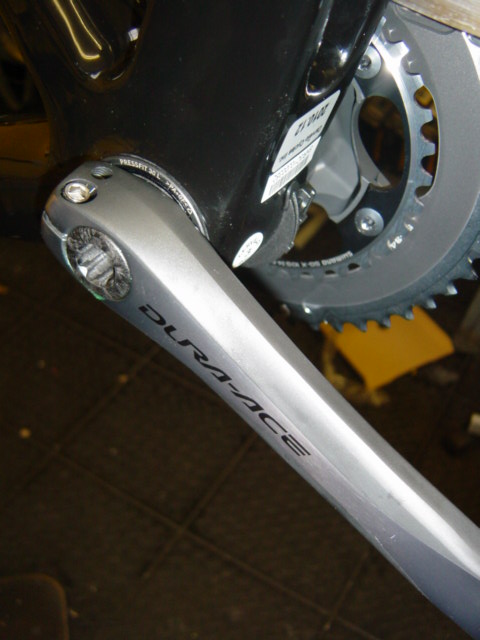
Shimano's crankset engineering is simply amazing. Their forged aluminum crankarms are lighter and stiffer than many carbon cranksets on the market, and I applaud them for resisting the pressure to switch to carbon simply for its exotic appearance. The new 7900 crank boasts a 20% increase in stiffness, a lightweight hollow big ring, and chainring bolts that thread in from the back for aerodynamics.

The 7900 brake calipers are not all that different from the previous generation, but one change that I'm particularly fond of is the introduction of a new cable tension adjuster. The new adjuster has a lower profile and stands the cable housing in a more vertical position than the previous model, making it less likely to interfere with other cables when turing the handlebars. It also no longer has a tiny circlip inside the adjuster that is often lost on previous generations of brake caliper.
One important note is that these calipers have a higher mechanical advantage than the 7800's, and therefore require more cable pull. See the description of the shift/brake levers for more information on this.

Front shifting is much lighter with the 7900 group. It's quite impressive how fast one can shift to the big chainring with such a light throw of the lever. There is also no trim necessary when in the big chainring due to a redesign of the cage profile.

I wouldn't say rear shifting is much quicker with the 7900 group, but they did lighten the rear derailleur with a carbon outer pulley plate and tweaks to the materials engineering in the derailleur body. Small weight savings were made in the cassette with a lighter and stiffer aluminum sprocket carrier. Modifications were also made to the tooth profile here to improve shifting, although again I have not noticed a great difference. I should note, however, that the comparison I'm making is against the already snappy shifting of the 7800 group.

Each 7900 chain is supplied with a quick link for easy removal and reinstallation. This is convenient if you prefer to remove your chain for thorough cleaning. The previous method of installing a special breakaway pin seems a bit primitive compared to this elegant solution. Note that the 7900 chain is directional. The links with the engraved logos should face out when properly installed. The link is also directional and should be installed as pictured here.
The Dura Ace shift levers have undergone an extensive redesign for the 7900 series. Here are some shots:

Most important to us in the fit process is the contour of the new lever hoods. They are much flatter than the previous model, which should help achieve a comfortable hand position. They also feature adjustable brake lever reach, which will help fit those with smaller hands. The shifter's attachment bolt is a bit harder to get at, as the hood must be peeled back from the front end of the lever, but it's no more difficult than attaching a Campagnolo Ergo shifter.

Because the new brake lever & caliper are designed for more cable pull than the 7800 parts, they are not recommended to be interchanged. The longer cable pull of the 7900 lever used with the 7800 caliper would result in a stiff lever feel, but actually a loss of braking power. A 7800 lever's short cable pull with a 7900 caliper would give you lots of braking power, but a squishy lever feel. This is due to an increase in the
mechanical advantage of the new brake caliper. Length of cable pull is a function of the caliper's mechanical advantage.
The late, great Sheldon Brown's site has
an informative page on mechanical advantage as it applies to the differences in cantilever vs. linear pull brakes. Although this is a new application, the physical principles are exactly the same.





 Posts


